Why Most AI Projects Fail in Production (And How to Avoid It)
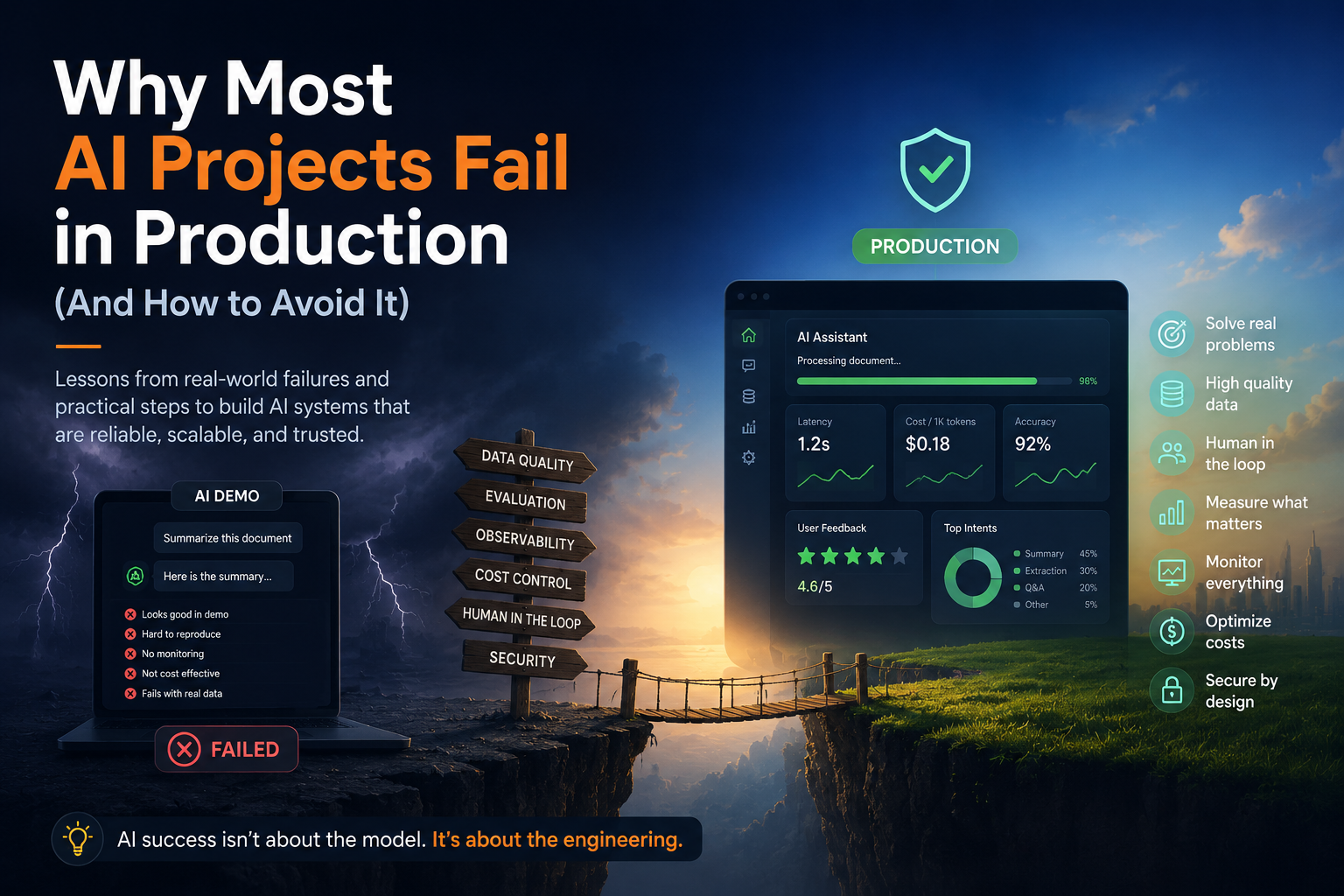
Building an AI demo is easy. Building an AI product that people trust, use, and depend on every day is an entirely different challenge.
Introduction
Over the past few years, artificial intelligence has moved from research labs into mainstream software development. Large Language Models (LLMs), computer vision, and intelligent automation have transformed how teams build products, making it possible to create features that would have seemed unrealistic only a few years ago.
With tools like ChatGPT, GitHub Copilot, Claude, and Gemini becoming part of everyday development workflows, organizations are under increasing pressure to “add AI” to their products. New prototypes appear every week, hackathons showcase impressive demos, and product roadmaps are filled with AI-powered ideas.
Yet despite all this momentum, many AI initiatives never make it into production. Or, if they do, they quietly disappear after a few months.
The problem usually isn’t that the models are incapable.
It’s that building a working demo and building a production-ready AI system require very different kinds of engineering.
A prototype only needs to answer the question:
“Can this work?”
A production system must answer far more difficult questions.
Can users trust the responses?
How do you measure quality?
What happens when the model is unavailable?
How much does each request cost?
Can the system explain its decisions?
How do you protect sensitive customer information?
How do you monitor whether the AI is actually improving the business?
These aren’t machine learning questions.
They’re software engineering questions.
In this article, we’ll explore some of the most common reasons AI projects fail in production and the engineering practices that can dramatically improve their chances of success.
1. Falling in Love with the Technology Instead of the Problem
One of the biggest mistakes teams make is starting with AI instead of starting with the business problem.
A project begins with questions like:
“Where can we use GPT?”
or
“Can we add an AI chatbot?”
Those questions sound exciting, but they often lead to solutions searching for problems.
Successful AI projects work the other way around.
They begin by identifying a repetitive, time-consuming, or error-prone workflow that genuinely benefits from intelligent automation.
For example:
- Summarizing lengthy customer support conversations.
- Extracting structured information from invoices or bank statements.
- Classifying incoming emails.
- Detecting anomalies in financial transactions.
- Helping developers search large documentation repositories.
In each case, AI solves a clearly defined problem rather than existing as a feature for its own sake.
The technology should serve the workflow, not define it.
2. Treating AI Like Traditional Software
Traditional software behaves predictably.
Given the same input, the same code produces the same output every time.
AI systems don’t always behave this way.
The same prompt can produce slightly different responses depending on the model, temperature settings, retrieved context, or even updates made by the provider.
That uncertainty changes how applications should be designed.
Instead of assuming the AI is always correct, production systems should validate responses, provide sensible fallbacks, and give users opportunities to review important decisions.
For low-risk tasks such as generating email drafts, occasional imperfections may be acceptable.
For medical advice, financial recommendations, or legal analysis, human review may be essential.
Designing with uncertainty in mind is one of the biggest differences between building AI products and building conventional software.
3. Ignoring Data Quality
There’s a popular saying in software engineering:
Garbage in, garbage out.
Nowhere is that more true than in AI.
A language model may be incredibly capable, but if it’s given incomplete, outdated, or inaccurate information, the quality of its output inevitably suffers.
Consider a customer support assistant.
If it retrieves outdated documentation, it may confidently recommend features that no longer exist.
If an OCR system processes blurry or incomplete documents, extraction quality declines regardless of how advanced the model is.
Before investing in larger models or more complex prompts, organizations should first examine the quality of the data they’re providing.
Often, improving the data produces better results than upgrading the AI itself.
4. Forgetting That AI Is Expensive
During development, it’s easy to overlook costs.
A few hundred requests to an AI model seem inexpensive.
Scale changes the equation.
An application serving thousands of users may generate millions of AI requests every month.
Token usage grows.
Inference costs increase.
Latency becomes more noticeable.
Without careful planning, AI can become one of the most expensive components of the entire platform.
Production systems should monitor token consumption, cache repeated responses where appropriate, choose models based on the complexity of the task, and continuously evaluate whether AI is actually providing sufficient business value for its cost.
Sometimes a smaller model, or even a simple rules engine, is entirely sufficient.
5. Skipping Observability
One of the first questions engineers ask when a traditional application misbehaves is:
“What happened?”
Logs, metrics, traces, and monitoring tools usually provide the answer.
Many AI systems, however, are deployed without comparable visibility.
When users complain about poor responses, teams often have little information about what prompt was sent, what context was retrieved, which model generated the answer, how long the request took, or why the output looked the way it did.
Observability is just as important for AI as it is for APIs and databases.
Production AI systems should record prompts, retrieved documents, response times, token usage, costs, confidence scores where available, and user feedback.
Without this information, improving the system becomes largely guesswork.
6. Removing Humans Too Early
One of the biggest misconceptions surrounding AI is that its ultimate goal is to eliminate human involvement.
In practice, the most successful AI products often keep humans in the loop.
Rather than replacing experts, they help experts work faster.
Consider a credit assessment platform.
Instead of automatically approving or rejecting loan applications, the AI prepares a recommendation, summarizes supporting evidence, highlights potential risks, and allows a loan officer to make the final decision.
Similarly, an AI legal assistant may draft contracts while leaving final approval to a lawyer.
This collaborative approach builds trust while reducing the impact of occasional AI mistakes.
Automation doesn’t always mean autonomy.
7. Measuring the Wrong Things
Many AI projects celebrate metrics such as:
- Number of prompts processed.
- Number of chatbot conversations.
- Model response time.
While useful, these don’t necessarily indicate business success.
A better question is:
Did the AI improve the outcome?
Depending on the application, that might mean:
- Faster document processing.
- Higher customer satisfaction.
- Reduced support tickets.
- Increased loan processing capacity.
- Fewer manual reviews.
- Improved fraud detection.
Ultimately, AI should improve business outcomes, not simply generate more responses.
Building AI Systems That Last
Successful AI products share several characteristics.
They solve real problems.
They rely on high-quality data.
They include appropriate human oversight.
They monitor quality continuously.
They control costs.
Most importantly, they’re treated as software products rather than AI experiments.
The underlying models will continue improving.
New capabilities will appear.
Costs will change.
But the engineering principles behind reliable software remain remarkably consistent.
Clear requirements, thoughtful architecture, observability, security, testing, and continuous improvement matter just as much in AI systems as they do anywhere else.
Final Thoughts
Artificial intelligence is undoubtedly changing how we build software.
It enables experiences that were once impossible and allows teams to solve problems in entirely new ways.
Yet AI alone is rarely enough.
The organizations that succeed won’t necessarily be the ones using the largest models or the newest tools.
They’ll be the ones combining strong software engineering practices with thoughtful AI adoption.
Building an impressive demo can take a weekend.
Building an AI product that users trust for years requires discipline, iteration, and an unwavering focus on solving real problems.
As the excitement around AI continues to grow, perhaps the most important question isn’t:
“How can we add AI to our product?”
Instead, it’s:
“What problem are we solving, and is AI genuinely the best way to solve it?”
The answer to that question often determines whether an AI project becomes a lasting product, or just another impressive demo.